
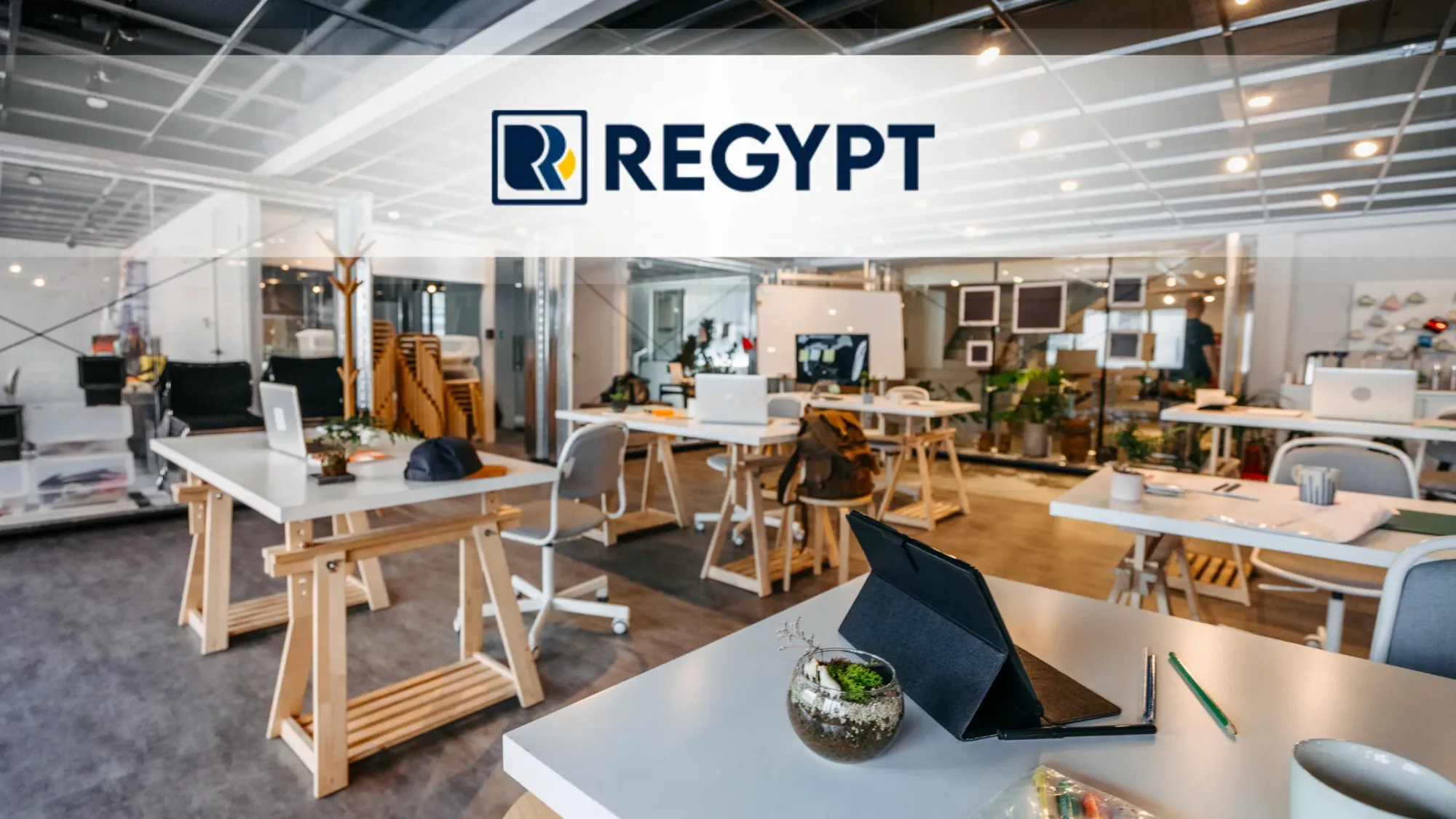
Have you considered renting a workspace that fits your freelance career or your startup team with flexible payment and no long-term contract? Co-working spaces are often the answer, but that decision shouldn't rest on the words "flexible" and "cost-saving" that appear in every article on the subject.
What you actually need to know is this: what a desk costs in New Cairo versus Downtown this year, which clauses cost startups money when they try to exit a membership, at what point co-working spaces become more expensive than a conventional office, and whether the address will hold up under scrutiny at the Commercial Registry when you incorporate.
This guide answers those questions specifically. It's written for the Egyptian market, because the trade-offs here traffic, power continuity, parking, and a moving currency don't resemble the generic advice written for London or Dubai.
What Are Co-working Spaces?
Co-working spaces are fully fitted workplaces rented by the hour, day, or month rather than under a multi-year lease. A single site usually houses several formats under one roof: open hot desks, dedicated desks, lockable private offices, and meeting rooms booked as needed. The operator handles fit-out, furniture, internet, cleaning, reception, and security, and recovers all of that within your membership fee.
The distinction that matters commercially is this: under a conventional lease you are buying space. In co-working spaces you are buying space + operations + optionality: the right to leave, expand, or contract without renegotiating a contract. That optionality is the real product, and it's what the premium over the raw price per square metre pays for.
These spaces suit entrepreneurs, students, freelancers, remote employees, and small teams. They have also entered the calculations of larger companies: JLL's report on the Cairo market for Q1 2026 points to notable growth in demand for flexible office space, with the vacancy rate holding steady at 9% across the office market generally.
How Do Co-working Spaces Work?
The model rests on sharing facilities and services among users, in exchange for a membership covering a set number of hours or a weekly, monthly, or annual period, delivering flexibility at a lower upfront cost. Once subscribed, you get a bundle of services included in the fee:
Ready-to-use desks
High-speed internet
Bookable meeting rooms
Reception and visitor handling
Printing and photocopying
Cleaning and maintenance
A kitchen or break area
Security and surveillance systems
A practical warning: the word "included" carries two meanings. Ask for the full rate card, not the facilities list, and confirm which items are billed by consumption.
Co-working Spaces vs. Conventional Offices
Co-working spaces | Conventional office | |
Getting started | Days; fitted and furnished | Two to six months for fit-out and utilities |
Contract | Daily, monthly, or annual | Multi-year lease, usually registered |
Upfront cost | Deposit + first period | Deposit + fit-out + furniture + infrastructure |
Scaling | Add or drop desks within the notice period | Renegotiation or a second premises |
Services | Included in the fee | Contracted and managed separately |
Control | Operator sets rules, hours, and layout | Full control of space and identity |
Cost as you grow | Rises linearly per head | Fixed, and cheaper per head above a certain size |
That last row decides most cases, and it's the one generic guides ignore.
Types of Co-working Spaces, and Who Each One Fits
Hot Desk: no fixed seat; you take whatever desk is free. The cheapest entry point, suiting freelancers and anyone in two or three days a week. Its hidden cost: packing up daily and losing your preferred spot at peak times.
Dedicated Desk: an assigned desk where you can leave your equipment. Suits daily attendees and anyone with a monitor setup. It typically costs 40–80% more than a hot desk at the same site; check the actual gap.
Private Office: a lockable room inside the centre with shared facilities. Suits teams of 2–15, client-facing work, and confidentiality-sensitive roles. This is where most funded startups land.
Meeting Rooms: booked by the hour, equipped with screens and presentation systems. Ask: how many rooms serve how many members? And does your plan include credit hours, or is every booking billed?
Virtual Office: a business address and mail service without a physical desk. Suits pre-revenue founders and remote-first companies. See the registration section below before buying one for incorporation purposes.

The Key Benefits of Co-working Spaces
The core benefit is reduced upfront cost, since you don't need to build out an office from scratch. Add to that contract flexibility, ease of expansion, a professional environment suitable for receiving clients, and the chance to collaborate and build new professional relationships.
But the deeper reason demand for co-working spaces keeps growing in Egypt isn't flexibility alone — it's how tight the conventional office market has become. According to JLL, Cairo's total office stock reached 2.8 million square metres following the delivery of more than 100,000 sqm of Grade A and B space during Q1 2026, with New Cairo accounting for close to 90% of that stock. Knight Frank projects total supply to grow 82% by 2029, with New Cairo still dominant at over 73% of the total.
Meanwhile, the scarcity of Grade A space is pushing prices up: Grade A buildings command an 18.4% premium over Grade B stock, per Knight Frank.
The practical consequence: a company that needs a professional address in New Cairo this quarter rather than in 2029 finds in co-working spaces the only realistic route to a Grade A address without a multi-year commitment. That is the actual mechanism behind the demand.
When Co-working Spaces Are the Wrong Choice
We list these spaces, and we'll still tell you when not to book one. Four situations where a conventional office serves you better:
A stable team above 15–20 people. Per-desk pricing scales linearly while a lease does not. Above a certain threshold, the arithmetic flips, and co-working spaces become the more expensive option. Rerun the comparison against your actual headcount before every renewal.
Confidentiality-sensitive work. Legal, medical, financial advisory, and HR functions face genuine exposure in open-plan settings: audible calls, visible screens, shared printers. A private office mitigates this partially; open floors do not.
A need for visual identity or custom build-out. If clients must walk into your reception under your signage, or you need a lab, studio, or server infrastructure, you need independent premises.
Dependence on total noise control. These spaces are collaborative by design. If your work demands deep focus eight hours a day, budget for a private office from the outset rather than discovering the problem in month two.
Can You Register a Company at a Co-working Address?
This is the question we're asked most, and most articles about co-working spaces skip it entirely.
Company registration in Egypt requires a genuine registered address: either an ownership document or a valid lease in the name of the company or its authorised occupant. The address is publicly recorded in the Commercial Registry held by the General Authority for Investment and Free Zones (GAFI). If you submit a lease, it must be drafted in Arabic, registered with the competent property authority, and valid for at least three months.
The virtual office product sold by co-working spaces may serve this purpose. Virtual offices can be accepted where they comply with Egyptian law, and some professional firms work with local providers offering compliant addresses for commercial and tax registration. But acceptance is not automatic. It depends on the operator issuing a properly drafted, registrable Arabic lease in your company's name, not merely a membership agreement.
Before you pay:
Ask the operator directly: do you issue an Arabic lease contract valid for GAFI? And request a redacted specimen.
Confirm they have done this for other clients, and how recently.
Consult your lawyer or accountant, since requirements vary by activity type and are subject to change.
We are not a law firm, and none of the above is legal advice. Verify your specific case with a qualified Egyptian lawyer or directly with GAFI.
Common Mistakes When Choosing Co-working Spaces
The first and most common mistake is deciding on price alone. The other recurring errors are renting a space that doesn't match team size, ignoring internet quality, and not reading the expansion and termination clauses.
A field checklist before signing:
Visit at 10 am on a Tuesday, not on a weekend tour. Occupancy, noise levels, and room availability at peak differ enormously from the quiet window most sales tours are scheduled into.
Run a speed test yourself, on their network, while you're there. Don't accept a quoted figure. Then ask: is there a backup line from a different provider, and what is the failover process?
Ask about power continuity specifically. Is there a generator or UPS? What does it cover? Does it power the whole floor, or only the lifts and servers?
Count the parking spaces and ask whether they're included. Knight Frank found that parking availability has become a more prominent factor in leasing decisions, pushing some companies to relocate to buildings with greater capacity. In Zamalek and Downtown, this is often the binding constraint.
Measure the commute at rush hour, not on a map. The shorter route beats the better building. And proximity to the metro in Maadi is a real advantage for teams spread across the city.
Read the exit clause before the amenities list. Notice period, deposit return timing and conditions, early termination penalties, and the operator's right to move you to another site or floor. This is where the money is, and it's the clause people skim fastest.
How to Choose the Right Co-working Space
Rank your criteria in this order, not another:
Total annual cost including tax and consumption-based fees, not the advertised monthly rate.
Rush-hour commute for you and your team.
The exit clause and notice period.
Internet quality and whether a backup line exists.
Power continuity.
Parking.
Security standards and meeting rooms.
Ability to expand within the same contract.
The right space depends on the nature of your business, your headcount, and your growth plans — not on price alone.
When Co-working Spaces Are the Better Option
If you run a startup: you get a fully equipped administrative space in the district you choose, on a term you set, without spending time and effort on a long-term lease decision, which is especially useful while you're still unsure how large your team will be in a year.
If you're a freelancer: an excellent option for hours you set yourself, in an environment that helps you focus and widen your professional network at a reasonable cost.
If you run an independent project: you can book a meeting room for your team only when you need it, with no financial commitment or lease.
Our Methodology and Sources
Market figures are drawn from JLL's Cairo market report for Q1 2026, from Knight Frank's research on the Cairo office market and reporting on it through Q2 2026, and from pricing published publicly on operators' own websites. Regulatory points are sourced from published Egyptian company formation guidance and are explicitly flagged as requiring professional verification.
Prices in this market change constantly; wherever a figure affects your decision, confirm it directly with the operator. If you find information here that is no longer current, write to us at [EMAIL], and we'll correct it and record the update date.
Book Your Space Now
Regypt lists co-working spaces in New Cairo, Maadi, Zamalek, Downtown, and Sheikh Zayed. Compare real listings side by side by location, capacity, and services, instead of relying on brochure claims. Browse available spaces
Not sure which format fits you? Send us your team size, budget, and preferred districts, and we'll come back with a shortlist, including telling you if a conventional office would serve you better.
Conclusion
Co-working spaces solve a specific problem: a fully serviced professional address, ready within days rather than months, with no multi-year contract, in a market where Grade A space is scarce and getting more expensive. That's a real advantage for freelancers, startups, and small teams.
It stops being an advantage above fifteen to twenty stable employees, when confidentiality is central to your work, or when you need premises carrying your own identity. Working out which side of that line you're on is the whole decision: compare on total annual cost, then commute time, then the exit clause.